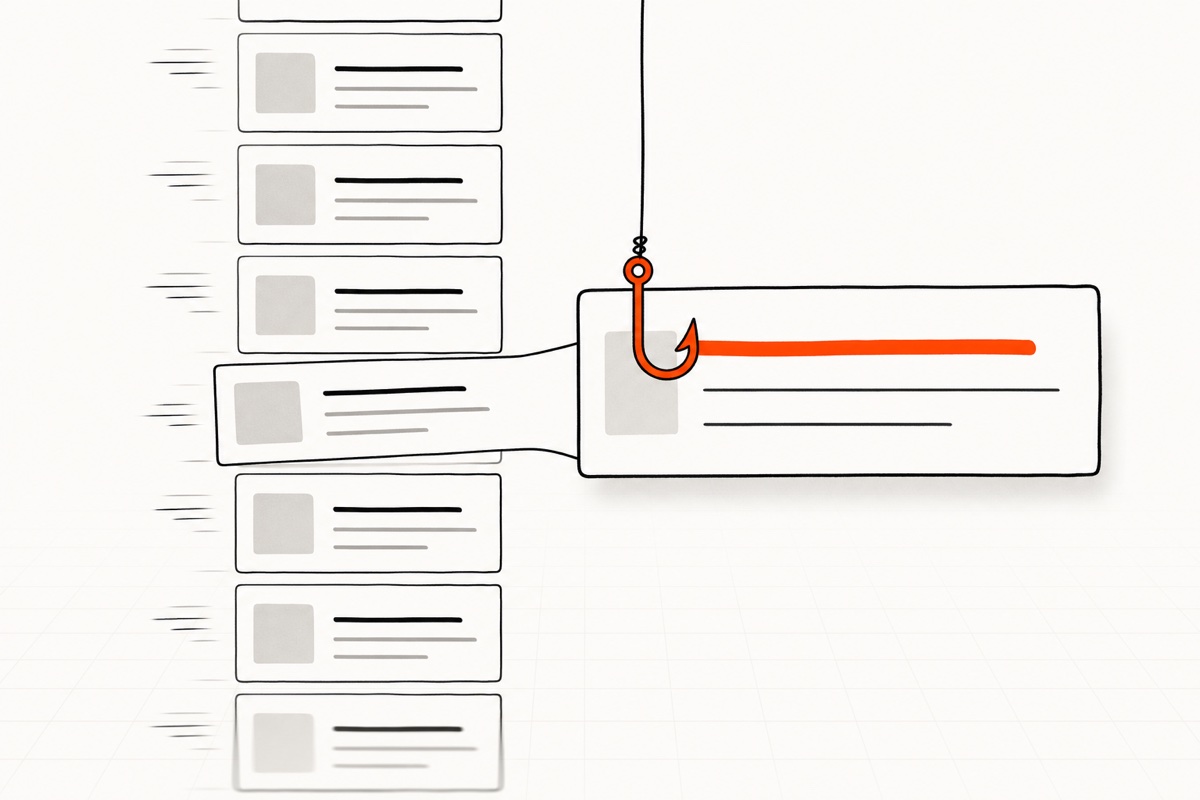
Most posts do not fail because the content is bad. They fail because nobody got past the first line. On every platform, the algorithm shows your post to a small test audience, watches whether they stop, and decides your reach from that. The hook is the whole audition.
The good news: hooks are a craft, not a talent. A handful of formulas cover almost every situation, and once you know them you will spot them everywhere. Here they are, with the psychology that makes each one work.
Why hooks matter more in 2026 than ever
Feeds got faster. Short video trained everyone to judge content in under a second, and text platforms adopted the same reflex. On LinkedIn, everything after the third line hides behind "see more." On X and Threads, your first line competes with an infinite scroll. On TikTok and Reels, viewers decide in the first two seconds.
The practical rule that follows: write the hook last, and spend a third of your writing time on it. A mediocre post with a great hook outperforms a great post with a mediocre hook, because reach happens before reading.
The 8 hook formulas that work everywhere
1. The specific number
"I grew from 0 to 4,200 followers in 90 days" beats "How I grew my following." Specificity signals a real story instead of recycled advice. Odd, precise numbers outperform round ones because they read as measured, not invented.
2. The mistake confession
"I wasted six months posting daily before I understood this." Confessions work because they invert the usual social media bragging, and curiosity about the lesson does the rest. This pairs naturally with show-your-work content from our 30 content ideas list.
3. The contrarian open
"Posting every day is killing your account." Take the accepted advice in your niche and open with its opposite. You must be able to back it up, but disagreement is the most reliable scroll-stopper in text feeds. We used it ourselves in how to grow without posting every day.
4. The direct callout
"If you manage social media for a small brand, read this." Naming your exact reader converts better than reaching everyone, because relevance beats reach at the individual level. The narrower the callout, the stronger the stop.
5. The open loop
"The best posting time is not what the studies say. It took me a year to figure out why." You promise a payoff and delay it. The reader's brain hates unresolved loops. Use sparingly and always pay it off, or trust erodes fast.
6. The before and after
"Last March: 200 views a post. This March: 40,000. Three changes." Transformation compresses a whole story into one line and implies a repeatable method, which is exactly what people want from their feed.
7. The cost of inaction
"Every week without a content system costs you your best ideas." Loss framing outperforms gain framing in feeds. What the reader is losing right now is more urgent than what they might gain someday.
8. The blunt truth
"Nobody cares about your product. They care about their problem." One short sentence that says the quiet part out loud. Works because it feels like honesty in a feed full of performance.
Adapting hooks per platform
The formula stays; the delivery changes. This is the same per-platform adjustment logic from our cross-posting guide:
- X and Bluesky: the hook may be the entire post. Cut everything that is not load-bearing.
- LinkedIn: the hook is line one, alone, with white space after it. Never bury it in a paragraph.
- Instagram and TikTok: the hook is spoken or on-screen in the first two seconds, then repeated in the caption's first line.
- Threads: conversational hooks win. A blunt question outperforms a polished statement.
- Reddit: hooks look like honest titles, not marketing. "How do you all handle X?" is a hook there.
Check how your first line actually renders on each platform with a post preview tool; a hook that gets truncated mid-thought is a wasted post.
The hook mistakes that kill good posts
- Warming up. "Hey everyone, hope you're having a great week! So I wanted to talk about..." is three deaths in one line. Start at the point.
- Clickbait without payoff. The open loop formula minus the payoff trains your audience to skip you. Reach follows trust over time.
- Being clever instead of clear. Puns and wordplay feel good to write and stop nobody. Clarity is the aesthetic.
- One hook for ten platforms. Copy-pasting the same first line everywhere ignores that each feed has its own reading speed and culture.
- Writing the hook first. You do not know the sharpest angle until the post exists. Draft, then extract the hook from your own best sentence, usually the last one you wrote.
A simple hook practice loop
Write three hook variants for every post: one number or specificity hook, one contrarian or blunt hook, one callout or question hook. Pick the strongest, save the other two in your ideas note; they are often next week's posts. If you batch your content weekly like our one-hour system, this adds five minutes and upgrades every post you publish.
Then let the numbers teach you. After a month, check which hook styles earned your best reach and lean in. Writing hooks in one sitting and scheduling everything through one composer for all 10 platforms makes the pattern easy to see. Try WriteOnce free for 7 days.
Frequently asked questions
What makes a good social media hook?
It stops the scroll by promising specific value or provoking genuine curiosity in one line, and the post pays off that promise. Specificity, tension and relevance to a named reader are the three ingredients that appear in almost every strong hook.
How long should a hook be?
One line, ideally under 12 words on text platforms and under 2 seconds spoken on video. If it needs a second line, the first line was not the hook.
Should the hook be different on every platform?
The idea stays the same; the phrasing adapts. Sharpest on X, spacious on LinkedIn, conversational on Threads, spoken and visual on TikTok. Adapting takes seconds once the core hook exists.
Do hooks work for small accounts?
Hooks matter most for small accounts. Large accounts get reach from their name; small accounts get reach only from the post itself, and the hook is the part the algorithm's test audience actually judges.
Write once. Post to all 10 platforms.
One composer, per-platform tweaks, scheduled in your timezone.