Most creators have a content volume problem that is actually a content packaging problem. They believe they need ten ideas a week, struggle to find them, and burn out. Meanwhile their one good idea from last Tuesday got a single post on a single platform and was never seen again.
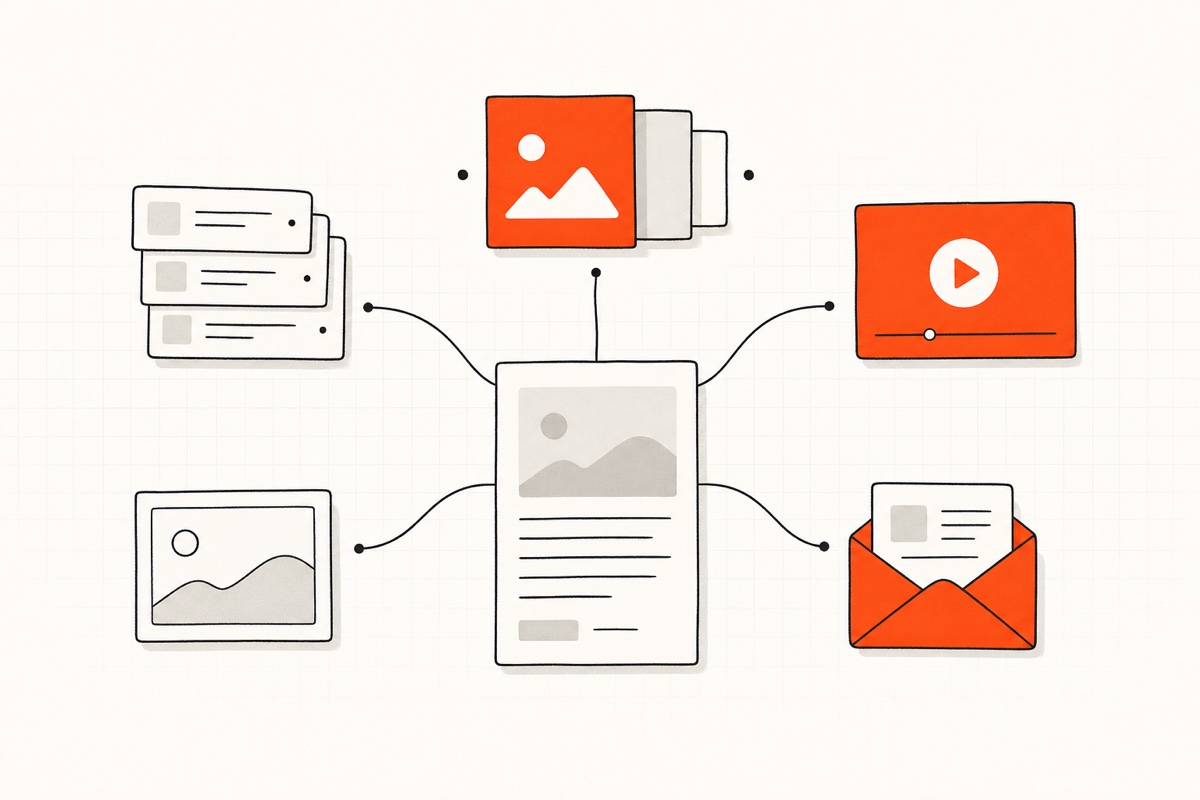
Content repurposing is the fix: take one idea that worked and package it into every format your platforms support. This is how one writing session becomes ten pieces of content, and it is the system behind every prolific account you follow.
What content repurposing actually means
Repurposing is transforming a piece of content into a different format: a blog post into a thread, a thread into a video script, a video into quote images. The idea stays, the packaging changes.
It is not the same as cross-posting, which publishes the same format across platforms. The two stack beautifully: repurpose an idea into three formats, cross-post each format to the platforms where it fits, and one idea becomes twenty-plus published posts. But repurposing is the step people skip, so that is what this guide covers.
Why repurposing beats constant invention
Almost nobody saw your post the first time. Average organic reach on most platforms is a small fraction of your followers, and your followers are a tiny fraction of your potential audience. Republishing an idea in a new format is not repetition to your audience; for most of them it is the first exposure.
Formats find different people. Some people watch videos and never read threads. Some save carousels and skip everything else. The same idea in three formats reaches three audiences that barely overlap.
Repetition builds positioning. Being known for something requires saying it more than once. The creators you associate with an idea have published that idea dozens of times in dozens of shapes.
You already validated it. A post that performed well is proof of demand. Repurposing your winners is the only content strategy with built-in market research.
Start with one proven post
Do not repurpose everything. Once a week, open your analytics and find the post with the best reach or engagement relative to your average. That post earned expansion. Everything below assumes you start from one proven post, roughly 100 to 200 words of substance.
The 10 formats: one idea, ten pieces of content
1. The X or Bluesky thread
Break the idea into 5 to 8 punchy steps, one point per post, hook first, summary last. A thread splitter does the mechanical part. Threads force clarity: if the idea will not thread, it was not structured.
2. The LinkedIn post
Rewrite the idea in first-person professional voice with a story opening: when you learned this, what it cost you before you did. LinkedIn rewards lived experience over listicles.
3. The Instagram or LinkedIn carousel
Each thread point becomes a slide. Title slide is the hook, one idea per slide, last slide is the takeaway plus follow prompt. Carousels are the most-saved format on Instagram, and saves are the strongest signal you can earn.
4. The short-form video script
Your hook becomes the first two seconds spoken to camera, three body points become the middle, takeaway becomes the ending. One script covers TikTok, Reels and Shorts. This single format unlocks the three biggest discovery engines in social media.
5. The quote image
Pull the single strongest sentence and set it on a branded background. Works on Instagram, Threads, Facebook and Pinterest. Lowest effort item on this list, reliably decent performer.
6. The contrarian follow-up
Write the counterargument to your own post and address it. "Everyone says X, and I said it too. Here is where it breaks." This is a new post for free, and it out-engages the original surprisingly often.
7. The FAQ answer
Take the best question from the original post's comments and answer it as a standalone post. Comment sections are pre-validated content briefs: someone literally told you what they want to know.
8. The Pinterest pin
Vertical image, keyword-rich title and description, linking to your site or the fuller version of the idea. Pins compound for months, making this the longest-lived item on the list.
9. The newsletter section
Expand the idea to 300 to 500 words with an example you could not fit on social. Your email list contains your highest-intent audience; your proven social ideas are exactly what they should get.
10. The Reddit discussion
Rewrite as a genuine question or experience report for a relevant subreddit, stripped of all marketing tone. Do not link to yourself. Reddit repays honest participation with the most detailed feedback you will get anywhere, which becomes next week's content.
The weekly workflow
Repurposing fits in about 90 minutes a week on top of a normal posting habit:
- Monday: check last week's analytics, pick the winner. Confirm it with an engagement rate calculator if the raw numbers are ambiguous.
- Same sitting: produce 3 to 5 of the formats above. Not all ten; pick the ones matching your platforms. The thread, carousel and video script cover most ground.
- Schedule everything. Spread the formats across the week so your feed is not five versions of one idea in two days, and time each platform using our best times to post guide.
Batching all of this into one session is the same principle as our one-hour weekly content system; repurposing simply feeds better raw material into it.
The bottleneck, as always, is publishing: 5 formats across 10 platforms is a lot of pasting into a lot of composers. WriteOnce collapses that step. You write once and publish to all 10 platforms, tweak per platform in one screen, and queue the whole week. Start your free 7-day trial.
The mistakes that make repurposing feel spammy
- Repurposing before validating. Expanding a post nobody engaged with multiplies a weak idea. Winners only.
- Same format, same platform, same week. Repurposing means new formats. Reposting the identical post twice in a week is what audiences actually notice and dislike.
- Zero adaptation. Screenshotting a tweet and posting it to Instagram is the lazy version. It works occasionally, but native formatting beats it every time.
- Ignoring the comments. The replies to each repurposed version are your next round of raw material. The system feeds itself if you let it.
Frequently asked questions
How long should I wait before repurposing a post?
You do not need to wait at all if the format changes. A Tuesday text post can become a Thursday carousel and a Saturday video the same week. For repeating the same format on the same platform, give it 4 to 6 weeks.
Does repurposed content perform worse than original content?
No. Format-native repurposed content regularly outperforms the original, because you are re-running a validated idea with better packaging. What performs badly is unadapted copy-paste between formats.
Will my audience get bored of seeing the same idea?
The math says no: with typical organic reach, most followers never saw the first version. The small overlap who see two versions get reinforcement, which is how you become known for the idea. Boredom comes from identical posts, not consistent themes.
What tools do I need for content repurposing?
A notes app, your platform analytics, something to make simple graphics, and a scheduler that covers your platforms. The scheduler is the non-negotiable one: repurposing multiplies your publishing volume, and manual publishing is where the system dies.
Write once. Post to all 10 platforms.
One composer, per-platform tweaks, scheduled in your timezone.